Tech Bros & Peptides: The Biohacking Obsession Coming for Your Feed


"Which peptides are you taking?"
It was a Sunday at my co-working space. The kind of Sunday where the building is half-empty and whoever is there is either deeply behind on something or deeply obsessed with something. I was making coffee when I overheard it — two guys at a standing desk, completely serious:
“Which peptides are you taking?” I paused to listen to the response because I never thought I’d be discussing beauty regimens at my crypto co-working space. Besides, it’s been literally two years since I started hearing about peptides and biohacking, all to feel and look younger. The first time I heard about NAD+ was from a crypto bro I met in Dubai. He was boasting about how he got a full health scan, including a bi-annual dose of an NAD+ shot because he was pushing 40 years old in an industry that rewards you capital if you look young. Although, he was super sweet, and had devastatingly sharp eyebrows, his look gave mature. In retrospect, I think he was on to something because not soon after I had a conversation with him, my TikTok feed flooded me with liposomal NAD+ supplements I caved and bought a few boxes, some of which are still sitting unused on my dresser.
Keeping Up With Discipline in a Syringe
It’s not so much the men obsessing over peptides, it’s equal parts women who are also mixing their own concoctions of skinny juice. This sudden obsession with biohacking may be spurred by the Kardashian’s who aired an episode featuring Bryan Johnson’s Don’t Die health and lifestyle plan, at the same time as the documentary was airing on Netflix. Now, the same group of people who used to post about cold plunges and intermittent fasting, also started posting about compounds with names that sound like wifi passwords or lines of code — BPC-157, Ipamorelin, Semax, TB-500., GHK-CU. Meanwhile, these are the same class of bioactive compounds that’s been quietly anchoring high-end skincare and health routines and anti-aging facials for years. These health people are on another level of beauty crazy. They are mixing the “blue” cooper-like powder with sterile water, loading it into syringes, and injecting it in the fat part of their bellies.
The same orange needles I use to see on my grandpa’s side of the bathroom counter to keep up with his diabetes, are the same ones tech bros are using to keep up with their DIY bio-hacking formulas. At home. Before work. Sometimes, apparently, at parties in San Francisco. According to open-source creator-driven sources, peptide raves are also a thing now. Underground events in San Francisco and New York where DJs play techno and attendees compare protocols. I wish I was making this up, but I’m not. The vibe right now is less Burning Man and more med spa with an 808. San Francisco wants to be Miami so bad, and they have more similarities that meets the eye. Moreover, the culture has a phrase for it: discipline in a syringe.
The Compounds For Looksmaxxing
Peptides were original used for muscle recovery and longevity. If you’re a professional athlete or know anything about that world, performance enhancing drugs are strictly prohibited. But the new frontier of the amateur athlete and looksmaxxing has moved into something far more interesting, and very much federally untested. People are getting their peptides shipped from the same group of distributors in China. Popular TikTok peptides like RETA (a colloquial nickname for retatrutide), are paired with GHK-CU for a “glow up” formula. In a post titled “Girl to girl, which peptides are you trying.” there are tons of comments boasting about the success reta. Even going insofar as saying, “reta is that girl.”
Meanwhile, RETA hasn’t even been FDA approved. These types of peptides are “triple-hormone receptors” currently under - development by Eli Lilly that are targeted to compete with GLP-1, GIP, and glucagon receptors to promote significant weight loss. Now that the conversation includes GLP-3s, the next generation beyond the GLP-1 drugs (Ozempic, Wegovy) are forces that are not only rewiring the cultural conversation around weight and appetite, but also around the viability of tech. However, according to Eli Lilly, GLP-3 receptor agonists don’t just reduce hunger, they appear to block intrusive thoughts about alcohol, food, and video games. Consequently, rumor has it that some Silicon Valley venture capitalists are not allowing founders to take weight loss peptides because they say it also blocks ambition.
The Office Refrigerator
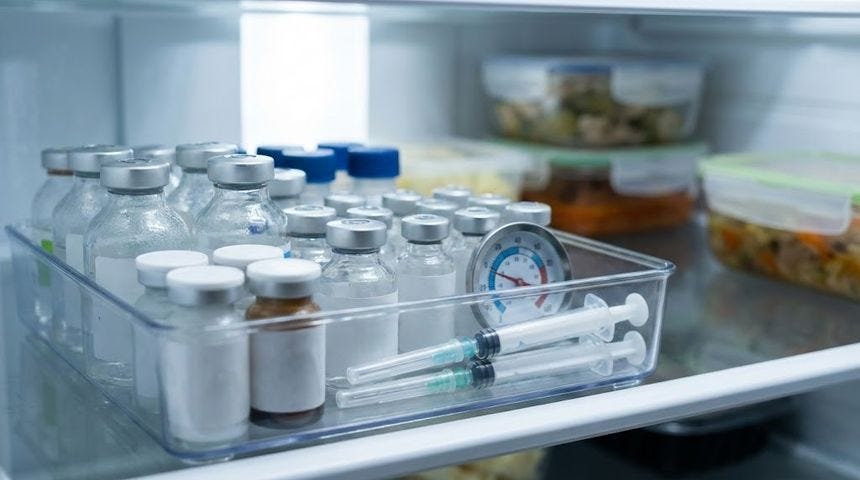
I use have a small pink beauty refrigerator filled with my caviar-infused serums, Korean face masks and other jade stone face sculpting tools. But now, these tools feel and sound juvenile compared to what the tech bros are doing. There’s a now-famous image making the rounds on tech Twitter: an office refrigerator with a dedicated drawer full of small vials, neatly labeled “Not for human consumption,” sitting right next to somebody’s lunch.
This is happening inside well-funded, venture-backed offices in San Francisco right now. And the infrastructure is being built around it. Superpower is a recently valued health startup that offers elite blood testing panels aimed squarely at the biohacking crowd. Function Health, co-founded by Dr. Mark Hyman, is another modern health company that uses your biomarker data to recommend supplements, and increasingly, peptides. These aren’t wellness blogs; they’re startups with real money behind them, building the supply chain for a behavior that doesn’t yet have a legal framework.
The numbers back up what I’m seeing in real life. US customs data shows that imports of hormone and peptide compounds from China doubled to $328 million in the first three quarters of 2025 alone. The global peptide therapeutics market is projected to hit $100 billion by 2030. The behavior is ahead of the regulation by years, given the defunding of health initiatives here in the US under the current Trump Administration.
The Optimization Rebrand (Again)
Here’s what I keep coming back to: this is the male reframing of beauty culture, running at full speed where everyone thinks they are their own personal Dr. Dolittle. Just in the last decade, healthcare aimed at women have focused on hormone rebalancing, PCOs, egg fertileness, and of course the bare minimum at this point -- our gut health, our collagen, our skin’s cellular turnover. (Side note: I’m very excited to report on my upcoming PDRN salmon sperm facial). We built entire industries around it. We got called vain and obsessive for it. But at the end of the rainbow, we were sold the same desire to feel better, to age slower, to perform at our best — through the language of beauty.
Now the same interventions, repackaged as “performance biology” and “longevity optimization,” are being treated as serious intellectual and entrepreneurial pursuits. I’m not hatin’. I’m genuinely fascinated. In one of my group chats, I asked my male friend, if they were taking any peptides, and they said yes, but didn’t really care to explain which one. The cavalierness of it all is what makes the health risk non-existent.
I digress...the peptide moment isn’t really about peptides. It’s about who gets cultural and capital permission to pursue self-optimization and what language they have to use to do it. Women say “I want to feel good in my body.” Men say “I want to optimize my performance.” The compounds are nearly identical. The reception? Not so much.
Disclaimer: None of this is physician-approved advice, please consult your medical physician before anything else.


